
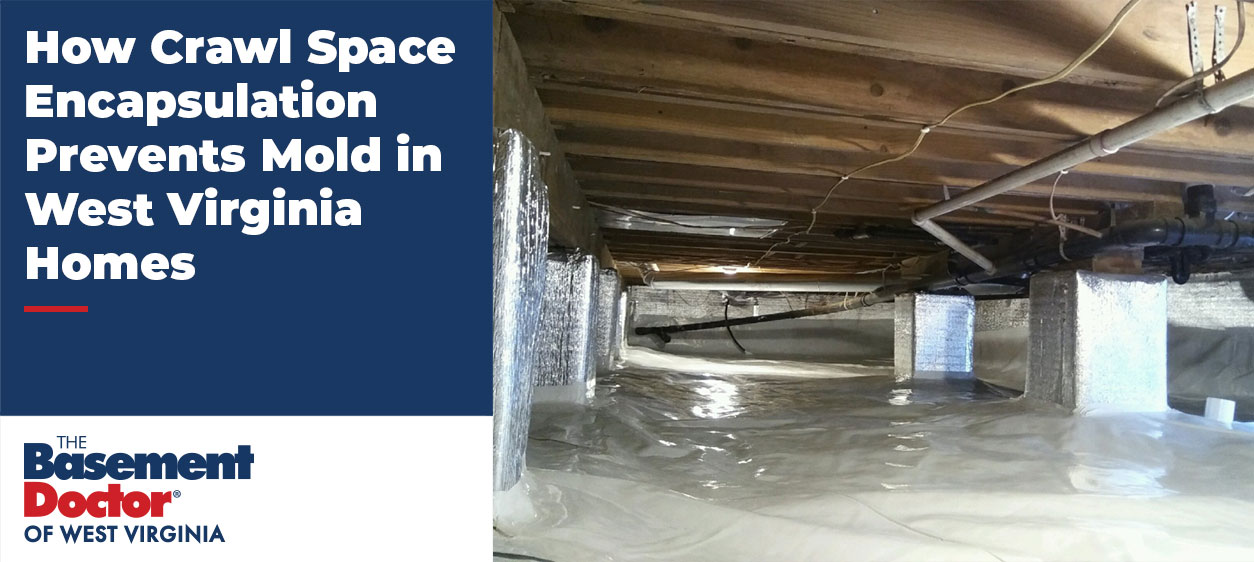
Your crawl space could be the biggest threat to your home’s air quality — and your family’s health. Traditional crawl spaces rank among the leading sources of mold in the home, and that mold doesn’t stay hidden below your floors. Poor indoor air quality, aggravated asthma, worsening allergies, and other health issues are all directly linked to crawl space mold contamination.
West Virginia homeowners face a particular challenge. The state’s humid climate and heavy rainfall create ideal conditions for moisture problems, and crawl spaces take the worst of it. Left unaddressed, dampness in crawl spaces leads to mold growth, insect infestation, and structural rot. Warning signs like musty odors, cold floors, and increased allergy symptoms are easy to miss — until the damage is already done.
Implementing proper crawl space encapsulation West Virginia homes can count on is a homeowner’s strongest defense against these problems. Done right, it cuts off moisture at the source, stops mold before it starts, and delivers lasting protection for your home and everyone in it.
This comprehensive guide covers why West Virginia crawl spaces are especially vulnerable, what warning signs to watch for, and how high-performance encapsulation protects your home and family for the long term.
Why West Virginia Crawl Spaces Are Especially Prone to Mold
West Virginia’s geography works against crawl spaces in ways that go beyond ordinary dampness. Three specific factors combine to make moisture problems here worse than in most other regions — and understanding each one helps explain why proactive crawl space mold prevention isn’t optional for West Virginia homeowners.
Humid Climate Meets Cold Underground Temperatures
Crawl spaces maintain ground-level temperatures, hovering between 55 and 66 degrees year-round. Warm, humid outdoor air enters through foundation vents and gaps — and when it hits those cooler surfaces, the chemistry changes fast. Relative humidity shifts by 2.2% for every degree of temperature change. On a typical summer day, 84-degree air at 75% relative humidity entering a 62-degree crawl space experiences a 22-degree temperature drop — enough to push relative humidity up by 48.4%.
That spike creates condensation on crawl space walls, floor joists, and every exposed surface underneath your home. Winter offers no relief either. Cold air with seemingly low moisture content still carries enough humidity to cause problems when temperature differentials are in play. The result is year-round moisture accumulation — conditions that mold thrives in, regardless of the season.
Clay-Heavy Soil and Water Drainage Issues
West Virginia’s soil composition adds another layer to the problem. Clay soil is dense with small pores that absorb and hold water for extended periods. Unlike sandy soil that drains quickly, clay traps surface water and groundwater right against your foundation, essentially turning the soil into a slow-release moisture reservoir.
The problem runs deeper than just water retention. Expansive clay soil damages the foundations of 1 in 4 homes, with annual insurance costs reaching $12 billion nationally. Clay shrinks when dry and swells when wet — that constant movement cracks and compromises foundation walls. Rainwater doesn’t drain away from your home; it sits in the soil immediately surrounding your foundation. That trapped moisture finds its way through foundation cracks and porous concrete directly into your crawl space.
The Stack Effect: How Crawl Space Air Enters Your Home
Even if moisture stayed perfectly contained in your crawl space, your home wouldn’t let it. The stack effect describes how warm air rises and escapes through the upper levels of your house, pulling replacement air from lower levels to fill the void. Your crawl space is the primary source for that replacement air.
Up to 50% of the air circulating inside your home can come directly from the crawl space. That air travels upward through gaps around ductwork, pipes, wiring, and subfloor seams. Mold spores, musty odors, and moisture — whatever is present in your crawl space — move with it into your living areas. During winter months, the heated air inside your home rises faster, intensifying the stack effect and pulling even more crawl space air upward throughout heating season.
Warning Signs Your Crawl Space Has a Mold or Moisture Problem
Catching these problems early saves you from costly repairs and protects your family’s health. The longer moisture goes unchecked under your floors, the more damage it does — to your home’s structure, your air quality, and your family’s well-being. Watch for these warning signs.
Musty Smell in Crawl Space and Living Areas
Notice a persistent earthy odor in your home? That smell is one of the earliest and most reliable warning signs of a crawl space moisture problem. Mold and mildew thrive in damp environments, releasing compounds that create a distinctive musty smell in crawl space zones. Thanks to the stack effect, contaminated air travels upward from your crawl space directly into your living areas — the smell follows right along with it.
Mold only needs 24 to 48 hours to take hold after a rain event or humidity spike. If that odor gets stronger after wet weather, moisture has already found its way in. Your crawl space’s wood joists and insulation are actively feeding the problem.
Sagging or Buckling Hardwood Floors
Soft spots near doorways, uneven surfaces, or visible warping in your floors are signs of serious trouble. Wood floors that appear scalloped, buckled, cupped, or sagging point to moisture seeping into floor joists, causing them to warp and rot over time.
By the time floors feel soft from above, structural damage has typically been building for years. Damp or spongy wood means moisture is actively breaking down your home’s structure. That needs structural attention right away.
Increased Allergy and Asthma Symptoms
Worried about worsening allergy or asthma symptoms at home? Mold spores circulating through your air supply could be the cause. Common signs include nasal stuffiness, chronic coughing, throat irritation, and skin rashes. Mold exposure can trigger severe asthma attacks. If symptoms improve when you leave home and return when you come back, your crawl space air quality deserves a closer look.
Higher Than Normal Energy Bills
Dealing with energy bills that keep climbing for no obvious reason? Your crawl space moisture problem could be costing you more than you realize. Wet insulation loses its ability to regulate temperature, compressing and shedding the air pockets that provide thermal protection. Your HVAC system picks up the slack by running longer and harder. Energy costs can spike by 15 to 25% when crawl space moisture is affecting your home.
Vented vs. Encapsulated Crawl Spaces: Performance Matrix
| Property Metric | Open, Vented Crawl Space | Fully Encapsulated Crawl Space |
| Relative Humidity Levels | High / Uncontrolled (Fluctuates with weather) | Stable (Maintained strictly below 50–55%) |
| Mold Growth Environment | High risk across wood joists and subfloors | Effectively zero (Moisture source eliminated) |
| Pest & Rodent Vulnerability | High (Open vents invite pests) | Sealed shut (Heavy barrier blocks access) |
| Subfloor Wood Integrity | Vulnerable to structural sagging/rot | Dry, stable, and protected long-term |
How Crawl Space Encapsulation Prevents Mold
Proper encapsulation tackles moisture from multiple angles — sealing, insulating, and actively removing the dampness that mold needs to grow.
Vapor Barrier Installation WV: Creating a Moisture-Proof Seal
The foundation of any encapsulation project is a heavy-duty vapor barrier. Professional vapor barrier installation WV standards require laying thick polyethylene sheeting — 12-mil to 20-mil thickness — across the entire crawl space floor. Standard, thin 6-mil retail material simply doesn’t hold up to West Virginia’s intense groundwater conditions.
The barrier extends 12 inches up foundation walls, with seams overlapping by 6 to 12 inches per local building codes. Our contractors seal every overlap with specialized tape and caulk, creating a waterproof seal that blocks ground moisture from evaporating into your crawl space. Cut off that moisture source, and you cut off mold’s food supply.
Sealing Vents and Insulating Foundation Walls
Open foundation vents invite humid outdoor air straight into your crawl space. When that warm air hits cooler surfaces, moisture condenses on floor joists and foundation walls — and mold follows quickly. Sealing those vents stops the cycle before it starts. Closed-cell spray foam insulation applied to foundation walls finishes the job, completing the thermal envelope and keeping moisture where it belongs — outside.
Installing Dehumidifiers and Sump Pumps
Sealing alone isn’t always enough. Active moisture removal keeps your crawl space dry even when conditions push back hard. A properly sized dehumidifier placed centrally ensures even air distribution throughout the space. Sump pumps installed at the lowest point automatically collect and remove groundwater before it becomes a standing pool. Together, these systems keep moisture levels consistently under control.
Preventing Wood Rot in Floor Joists
Encapsulation keeps wood moisture content below 19% — the exact point where wood rot begins. Dry wood holds its strength, resists fungal decay, and protects the structural integrity of your home for the long haul. That means your floor joists, beams, and subflooring stay solid for years to come.
Additional Benefits of Crawl Space Encapsulation
Crawl space encapsulation does more than stop mold. West Virginia homeowners who invest in proper encapsulation see real financial returns, stronger structural protection, and a home that’s simply better to live in. The Basement Doctor of WV provides advanced crawl space systems that families trust to clean up damp homes across Charleston, Huntington, Parkersburg, Morgantown, and Wheeling.
- Lower Energy Costs and Improved HVAC Efficiency: A sealed crawl space takes real pressure off your heating and cooling system. Homes with closed crawl spaces save 15% or more on annual heating and cooling energy compared to homes with vented crawl spaces.
- Increased Home Value and Marketability: Encapsulated crawl spaces increase home values by an average of 10%. Buyers notice a documented encapsulation system because it tells them the moisture problem is already solved, helping your property sell faster.
- Pest and Rodent Prevention: Mice, termites, ants, and spiders all enter your home through open vents and foundation openings. Encapsulation closes those entry points to prevent pest infestations.
- Extended Lifespan of Structural Components: Stable temperatures and controlled humidity protect more than just wood. HVAC equipment, plumbing, and wiring running through your crawl space all benefit from a dry, consistent environment.
Your Next Step Toward a Drier, Healthier Home
Musty smells, cold floors, worsening allergy symptoms — your crawl space is trying to tell you something. West Virginia’s climate makes moisture problems nearly inevitable for homeowners with unprotected crawl spaces, but the damage doesn’t have to keep building.
Sealing your foundation cuts off moisture at the source, preserves your home’s structural integrity, and delivers real energy savings year after year. Your home is one of your biggest investments — and it deserves a permanent solution, not a temporary fix.
Worried about what might be happening beneath your floors? The Basement Doctor of WV crawl space repair and restoration team is ready to help. We start every project with a free crawl space inspection WV homeowners can easily book online. We will walk you through exactly what we find and give you honest, engineered recommendations with no pressure.
Contact us today to schedule your free inspection and take the first step toward a drier, cleaner, and healthier home.