
Hillside homes in West Virginia deal with foundation challenges most homeowners never anticipate. Shifting soils, seasonal freeze-thaw cycles, and relentless gravity put your home’s foundation under constant pressure — and standard repair methods often fall short on a slope.
Helical piers offer a proven answer. These steel foundation supports drill past weak, unstable surface soil to anchor directly into stable bedrock below. A single helical pile can support between 10 and 200 tons, making them one of the most reliable options for hillside foundation stabilization across the Mountain State.
The Basement Doctor West Virginia has spent over three decades protecting WV homeowners from soil slippage and foundation damage. We understand West Virginia hillsides — the clay-rich soils, the steep grades, and the unique conditions that put your home at risk season after season.
This article covers the warning signs that your hillside home may already be shifting, how helical piers work on slopes, and why bedrock anchoring delivers lasting stability where other solutions simply cannot.
The Warning Signs: Is Your Hillside Home Shifting?
Your hillside home will tell you when something is wrong. Catching these warning signs early keeps a manageable repair from turning into a major foundation failure. Here is what to watch for.
Stair-Step Cracks in Brick and Block
Diagonal cracks zigzagging through mortar joints between bricks — creating a staircase pattern along exterior walls — are a clear red flag. These cracks typically show up near corners or window openings, where uneven soil pressure puts the most stress on your foundation. West Virginia’s clay-rich soils expand when wet and shrink during dry periods, creating constant movement that works against your brick veneer over time. Widening gaps paired with interior wall separation mean it’s time to schedule a foundation inspection.
Doors and Windows That Stick or Won’t Close
Doors that require extra force to shut. Windows jamming halfway. Locks that no longer align. These are not minor annoyances — they are signs that your foundation is sinking or tilting unevenly beneath your home. Diagonal cracks at the top corners of door and window frames confirm it. The frames are responding to movement happening below.
Floors Sloping Toward the Downhill Side
Uneven floors point to differential settlement — one section of your foundation dropping while another holds its position. Walk across the room. Notice if objects roll on their own or if standing feels off-balance. Sagging floors on hillside properties often come with weakened crawl space supports, where downslope pressure adds to standard settling issues. Left unaddressed, this kind of movement compromises your home’s structural integrity.
Gaps Between Walls and Ceilings
Visible separations where walls meet ceilings are more serious than they look. Gaps wider than 10mm put stress on your home’s structural framing and can affect plumbing and electrical systems running through those spaces. On sloped properties, these gaps tend to worsen on the downhill side first — soil slippage pulls that section of the house down while the ceiling framing stays put. Growing gaps mean the settlement is still active.
Visible Soil Erosion Around the Foundation
Exposed foundation concrete, small gullies forming after rainfall, standing water pooling near your home, or footing hardware becoming visible — all signs that runoff has washed away the soil protecting your foundation. Water sitting against your foundation steadily weakens the soil structure your home depends on. This is when soil slippage repair and stable bedrock anchoring become urgent, not optional.
What Are Helical Piers and Why Do They Work on Slopes
Helical Piers Defined: Steel Screws for Unstable Ground
A helical pier is a steel shaft with helical-shaped plates welded along its length. These plates work exactly like a large screw — which is why contractors also call them screw piles or helical anchors. Hydraulic rotary equipment drives each pier into the ground by rotating it downward through soil layers, much like threading a bolt through wood. No excavation needed. The helical plates cut through the soil as they turn, generating consistent downward force throughout the process.
What makes this method reliable is torque monitoring during installation. The torque applied during drilling directly correlates to the pier’s load-bearing capacity. Once the required torque is reached, the pier has confirmed it’s embedded securely in competent soil. There’s no waiting period, no curing time — your home’s weight can transfer to the piers within hours of installation.
The Bedrock Advantage: Anchoring Past Weak Topsoil
Surface soil on West Virginia hillsides simply cannot be trusted. Heavy rainfall shifts it. Seasonal freeze-thaw cycles loosen it. Year after year, that instability works against your foundation.
Helical piers solve this by bypassing the problem entirely. Technicians drill past the active surface zone to reach load-bearing soil or bedrock far below. The helical plates then distribute your structure’s weight across a larger soil area at that depth. The result is stable bedrock anchoring that surface-level supports cannot come close to matching.
Why Helical Piers Outperform Traditional Concrete on Hillsides
Traditional concrete piers sit on soil. Helical piers grip it — at multiple depths simultaneously. That’s a meaningful difference on a slope.
Concrete also demands excavation, backfilling, and significant curing time before it can accept any structural load. West Virginia helical pier installation requires none of that. There’s no excavation work, no disruption to your hillside, and no waiting. Once installed, the piers transfer weight immediately. For hillside foundation stabilization, that speed matters. Helical piers complete in hours rather than days — reducing equipment costs, minimizing site disruption, and delivering superior grip in the shifting ground conditions that West Virginia hillsides are known for.
How The Basement Doctor Stabilizes Hillside Foundations in WV
Every hillside property is different. Soil depth, moisture levels, and load-bearing capacity vary significantly from one site to the next — even across short distances. That’s why The Basement Doctor West Virginia starts every project with a thorough site assessment before a single piece of equipment arrives.
Site Assessment: Knowing What’s Beneath Your Property
Our team identifies the depth and type of load-bearing strata beneath your foundation. Soil borings reveal where competent bearing soil exists, guiding pier placement decisions specific to your property. Nothing gets estimated. Nothing gets assumed.
Torque measurement confirms each pier reaches its required load capacity during installation. Engineers apply the formula Qu = Kt x T — where installation torque (T) multiplies by a torque factor (Kt) to calculate ultimate load capacity (Qu). This relationship, refined through 50+ years of field observation, provides real-time verification that every pier is performing exactly as designed. For foundation repair WV homeowners depend on, that kind of certainty matters.
Installation Process: Minimal Excavation, Maximum Stability
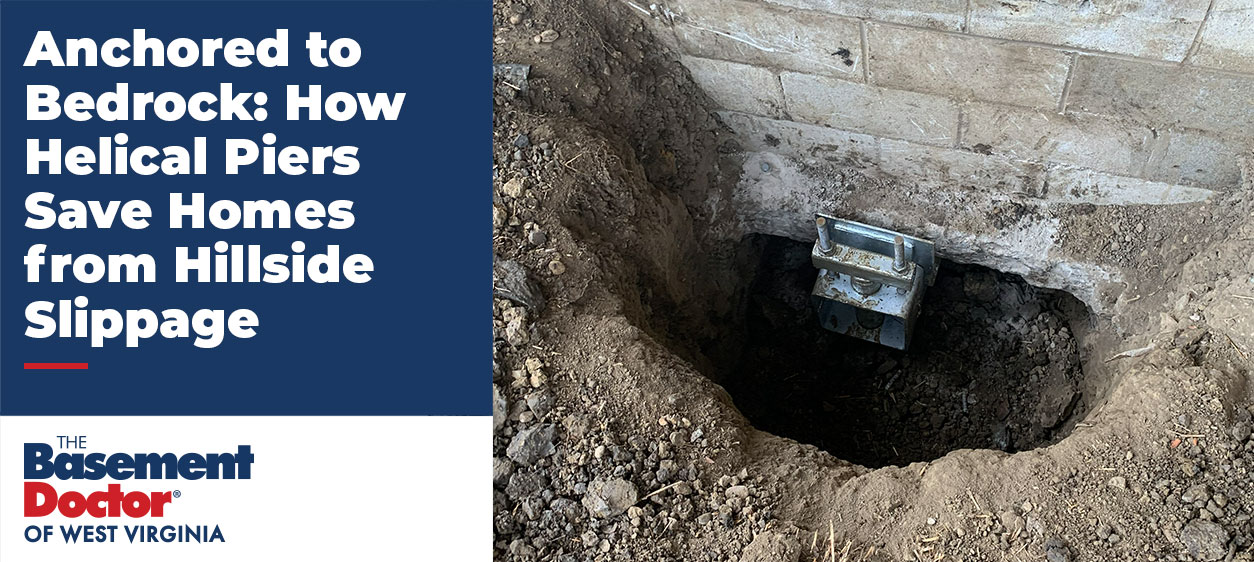
Our technicians excavate small access holes — 3 feet wide, 3 feet long, and 3 feet deep — at calculated intervals along your foundation. This targeted approach preserves your hillside landscaping while exposing the footing for bracket attachment. A hydraulic drive head then screws each helical pile into the ground, with digital torque monitoring tracking pressure readings throughout the entire process.
Piers are driven until reaching target torque values, typically between 3,000 and 7,000 foot-pounds for residential applications. Most piers penetrate 15 to 40 feet deep, anchoring well past the unstable surface layers into solid, load-bearing soil below. The full installation takes 2 to 4 hours for most residential foundations. Once complete, steel brackets transfer your home’s weight directly from the shifting soil to the piers — and the problem stops there.
30+ Years of West Virginia Topography Experience
West Virginia mountain terrain does not behave like flat-ground construction sites. Clay-rich soils shift with seasonal moisture. Load-bearing strata depth changes across even small properties. Cookie-cutter solutions fail here.
The Basement Doctor West Virginia has built project-specific engineering into every job we handle — because skipping proper torque documentation leads to a 30 to 40% failure rate in helical pier installations. With three decades of regional experience behind us, we make sure that never happens on your property. You can count on us to get it right the first time.
Real-World Applications: Where Helical Piers Save WV Homes
Helical piers work across a wide range of hillside situations. Whether your home is already showing signs of settlement or you’re building new on a grade, these steel foundation supports deliver reliable, permanent results.
Foundation Repair for Settling Hillside Homes
Already dealing with cracks, sticking doors, or sloping floors? Helical piers halt active foundation settlement without requiring full excavation. Steel brackets connect your existing footings directly to piers anchored in competent soil below the unstable surface layers. Your home’s weight transfers off the shifting ground and onto solid support below.
This foundation repair WV solution permanently stops further settlement — and in many cases, your structure can be lifted back toward its original position. Cracks close. Doors return to proper function. Your home stabilizes.
Slope Stabilization for Eroding Properties
Battling soil erosion on your property? Helical piles anchor embankments and slopes that are actively losing ground. Strategic pier placement resists the gravity forces that pull soil downslope season after season. No heavy excavation equipment tears up your yard — installation preserves the natural environment around your slope while securing it from the inside out. Your property stays protected from progressive erosion damage without the disruption traditional solutions require.
Preventive Anchoring for New Construction on Grades
Building on a hillside with poor soil conditions? Helical piers give builders a solid foundation from day one. Structural loads distribute directly to stable soil regardless of depth, eliminating the need for costly retaining walls or extensive excavation. Load-bearing capacity is available immediately after installation — no curing period, no delays.
The Basement Doctor West Virginia installs helical anchors on residential new-construction projects throughout the region, keeping timelines on track without cutting corners on structural integrity.
Don’t Wait for the Next Rainfall
Noticed cracks widening on your hillside home? Doors sticking that used to close without effort? These aren’t cosmetic issues — they’re your foundation telling you something is wrong.
Helical piers stop that movement permanently. They anchor past the unstable surface soil that West Virginia hillsides are known for and reach the stable bedrock below, giving your home the solid footing it needs for the long term.
The Basement Doctor West Virginia has protected Mountain State homes for over 30 years. We know this terrain, and we know what it takes to stabilize a home on a slope the right way — no shortcuts, no guesswork.
Your home is one of your biggest investments. Don’t let soil slippage threaten it. Contact The Basement Doctor West Virginia today for a FREE inspection, and let our foundation repair specialists take care of the rest.